
Menominee County Most Wanted Status
Skip the search for a Sheriff's wanted gallery. This county has none. The Sheriff's published material offers no browsing page, no warrant lookup, no reward program, no Crime Stoppers feature, no archive, and no regular posting schedule. There isn't even a "Warrant Wednesday" style feature. No official page lists names, photos, alleged offenses, last known locations, or caution notices. Recreating those details from news stories or private databases would just be guesswork, and mixing in a similarly named Michigan county makes things worse.
That gap matters more than it might seem. A curated wanted list is one thing; a question about one person's warrant is another, and it belongs with the authority that issued it. The Menominee County Sheriff contact page is the published route for county questions. It won't display a result on screen, though. It simply points an inquiry toward the right office.
Menominee County Warrant Check
A warrant check here runs through four pathways: county, state court, tribal, and federal. Menominee County mixes county land with reservation territory. That split cuts deeper here than almost anywhere else. County agency questions go to the Sheriff. State cases may appear in a public case entry, though the court system controls that path. Tribal Police and Tribal Court stand apart, so a Wisconsin state search never covers tribal matters completely.
| Actual source | What its status path can address | Limit to keep in mind |
|---|---|---|
| Menominee County Sheriff 715-799-3357 | County agency routing and actual local contact direction. | No public online warrant query or local wanted list was found. |
| WCCA and the County Clerk of Courts 715-799-3313 | Appropriate state-case follow-up and issuing-court routing. | WCCA is a public case index, not complete warrant confirmation or a tribal-court search. |
| Menominee Tribal Police and Menominee Tribal Court | Tribal authority and tribal-court routing for tribal matters. | The research did not verify a public tribal online warrant search. |
| U.S. Marshals Service, Eastern District of Wisconsin | Federal district wanted information and its own tip option. | It is not a Menominee County list or a local warrant-confirmation service. |
Someone facing a possible warrant should work through counsel or the issuing court directly. A contact line can confirm where an inquiry goes. It cannot resolve the record itself; that rests with the responsible authority. And an empty online result settles nothing either way.
Menominee County Warrant Types
"Warrant" covers a lot of ground. The terms below are high-level court and law-enforcement labels, not interchangeable ones. Which category fits a given Menominee County matter, if any does, is a call for the issuing court or agency to make.
| High-level category | Plain-language meaning | Proper Menominee path |
|---|---|---|
| Arrest warrant | A court-authorized process directing law enforcement to take a named person into custody in connection with an alleged offense. | Ask counsel or the issuing court, with the Sheriff as the county agency routing contact when appropriate. |
| Bench warrant | A court order that can arise from a court-process issue, including an alleged failure to appear. Its exact basis must be verified with that court. | Use the state-court or tribal-court path that issued the order. |
| Tribal warrant | A process within the Menominee tribal justice system, separate from Wisconsin Circuit Court Access. | Contact Menominee Tribal Police or Menominee Tribal Court. |
| Federal wanted notice | A federal matter handled through a federal authority, not a county booking or county wanted-list result. | Use the U.S. Marshals Service only when an official federal path is established. |
A warrant and a case outcome are different things. The disposition comes later, when the court resolves the matter through a dismissal, a plea, a judgment, or some other ruling. State case follow-up runs through WCCA and the Clerk. Tribal Court runs its own proceedings entirely. That division is why custody status, case details, and final outcome should never be mashed into one assumed record.
Note: Menominee and Shawano share a state circuit, so a hearing location may differ from the arresting agency or the custody site.
Menominee County Court Warrant Routing
The state-court path has a local twist. Under Wisconsin Statute § 753.34, Menominee and Shawano operate as a joint circuit. A Menominee-origin state case can therefore be heard in Shawano. Seeing that location tells you nothing about where an arrest happened or who issued the process. Pull the caption and case number before reading anything into a court display.
For a focused question, follow the official sequence. It keeps a name match, an old article, or a third-party site from being mistaken for the real record.
- Identify whether the known event points to the County Sheriff, a Wisconsin state case, Tribal Police, Tribal Court, or a documented federal matter.
- For a county agency question, call the Sheriff at 715-799-3357 and ask for the correct routing contact.
- For an appropriate state case, check the public WCCA entry by confirmed name or case number, then contact the Clerk at 715-799-3313 for the issuing-court path.
- For a tribal matter, use Tribal Police or Tribal Court rather than assuming WCCA includes it.
- Have counsel or the issuing court address a possible warrant directly. Do not rely on a search result as a final answer.
For state-case routing, start with the Clerk of Courts contact page. Two limits apply. The Clerk cannot make judicial calls. WCCA also leaves certain documents and confidential records off screen. When the question turns to a booking, or where someone is held after a documented law-enforcement event, the county-wide Menominee record routes keep the Sheriff, the Tribal Facility, the court, and later DOC paths separate.
The Clerk contact source carries the published state-court contact route for the county.
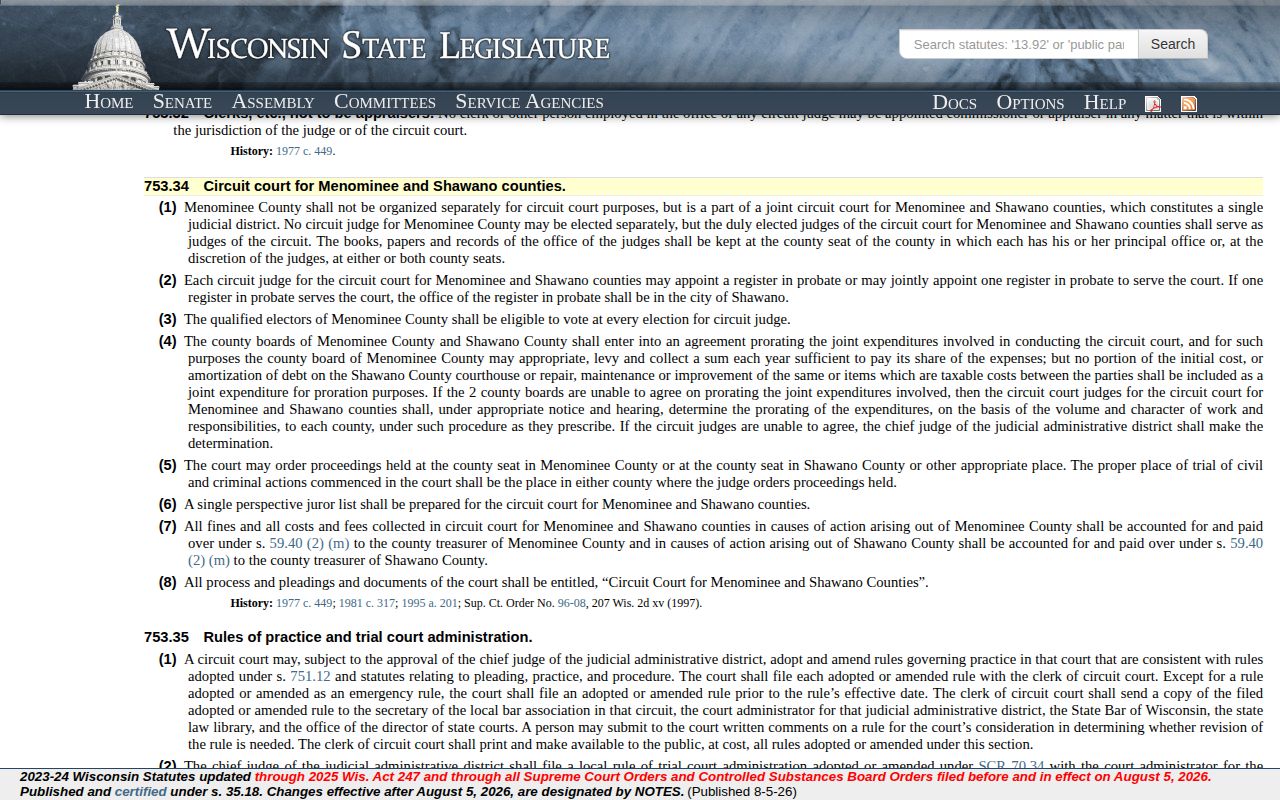
That contact page routes inquiries into the state court system and nothing more. It shows no warrant result, no full case file, and no tribal-court record.
Menominee Warrant Tip Boundaries
The Menominee Tribal Police tip form does one narrow job: it passes safety information to Tribal Police. Identifying fields can be left blank. What it is not matters just as much. It is not a searchable wanted database. It is not a record-confirmation tool or a reward program. Save it for information that truly belongs with Tribal Police, and call emergency services for any immediate threat.
The official Tribal Police tip form provides the pathway described here.
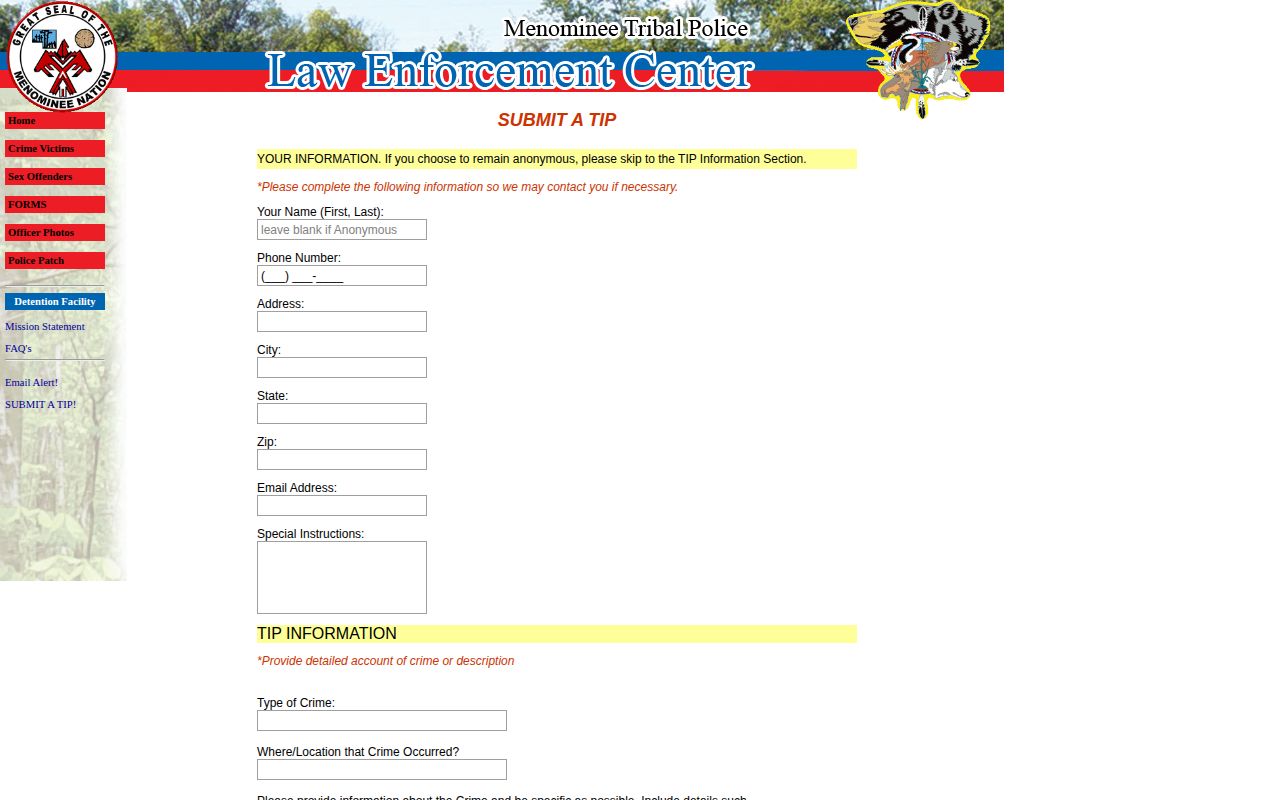
Keep the tip form separate from any public wanted list. It will not show you a person's custody status, charge, court result, or any reward terms. The two tools simply do different jobs.
Menominee County also lacks a verified Sheriff app or booking-photo app that works as a steady wanted-list source. The Sheriff's Facebook page and VINE handle updates and notifications. Neither one serves as a public display of active warrants. An alert label alone should never be read as a roster of people sought by law enforcement.
Federal channels sit on their own track. The U.S. Marshals Service Eastern District page carries its own federal information and tip option, but it cannot tell you a local matter is federal. Nor can it confirm that a county warrant exists. Treat each route as answering only its own question.
Menominee County Warrant Alert Limits
Menominee County's official alert tools do narrow work. The Sheriff points to a branded Facebook page. It also points to Wisconsin VINE. Neither one is a public warrant list, a booking-photo source, or a live custody roster. VINE sends notifications, plain and simple. It cannot tell you whether a county, tribal, state, or federal record exists.
Tribal Police lists an Email Alert label next to its tip pathway. Follow that label and you land on a sex-offender-registration-network disclaimer. It is not a verified booking-alert sign-up. That tells you nothing about arrest notices. The Crime Victims page links Wisconsin VINE and a local support contact. Those are safety resources, not warrant lookups.
There is no Sheriff mobile app here. No jail-information app or booking-photo app appears on the official local sources. That gap matters. An app store listing or a generic alert label can look like a status system when it is not. For a possible Menominee County warrant, the direct routes work best: the Sheriff, the Clerk, Tribal Police, the Tribal Court, or a confirmed federal channel.
Note: Alert tools may help with safety, but none of them publishes a complete local warrant list or court outcome.
Menominee County Warrant Safety
Take safety questions to the right authority, not to the subject of an online claim. An immediate emergency means 911. For a non-emergency county routing question, the Sheriff's published line is the one to use. Keep Tribal Police and the two court systems distinct from each other. The contacts that follow are starting points for reaching the responsible office, not a list of confirmed warrants or a stand-in for legal counsel.
Emergency
Call 911 for an immediate threat or active emergency.
Menominee County Sheriff's Office
W3269 Courthouse Lane
Keshena, WI 54135-0190
715-799-3357
After-hours non-emergency dispatch: 715-799-3881
Menominee County Clerk of Courts
W3269 Courthouse Lane
Keshena, WI 54135-0279
715-799-3313
Menominee Tribal Police
W3293 Wolf River Road
Keshena, WI 54135
715-799-3321
Menominee Tribal Court
P.O. Box 429
Keshena, WI 54135
715-799-3348
Charges shift as a matter moves from agency record to court. Warrant references change too. Cases get reduced, dismissed, or resolved some other way. Before treating any claim as settled, confirm the final outcome with the court that handled it.
The names and numbers above mark routes, not results. Use them to reach the responsible authority with a focused question about a known agency or court matter. Menominee County runs county and tribal systems in parallel, so that context matters. A state-court reference does not turn a tribal matter into a WCCA record. A county contact never overrides the issuing court's own authority.